Flute Drum is one of the most mechanically demanding components in a cigarette making machine — a flute drum cigarette machine component that operates at extremely high speeds, handling individual cigarettes thousands of times per minute during the transfer stage of production. Its condition directly determines cigarette transfer quality, and when it wears or becomes damaged, the impact on production output and reject rates is immediate.
This guide explains exactly what Flute Drum is, how it works, why it wears out, and what maintenance engineers should look for when deciding whether to replace it. For related component guides see our articles on Garniture Assembly, Suction Band, Cut-Off Knife, Garniture Tape, and Cigarette Rod Formation Problems.
What is Flute Drum?
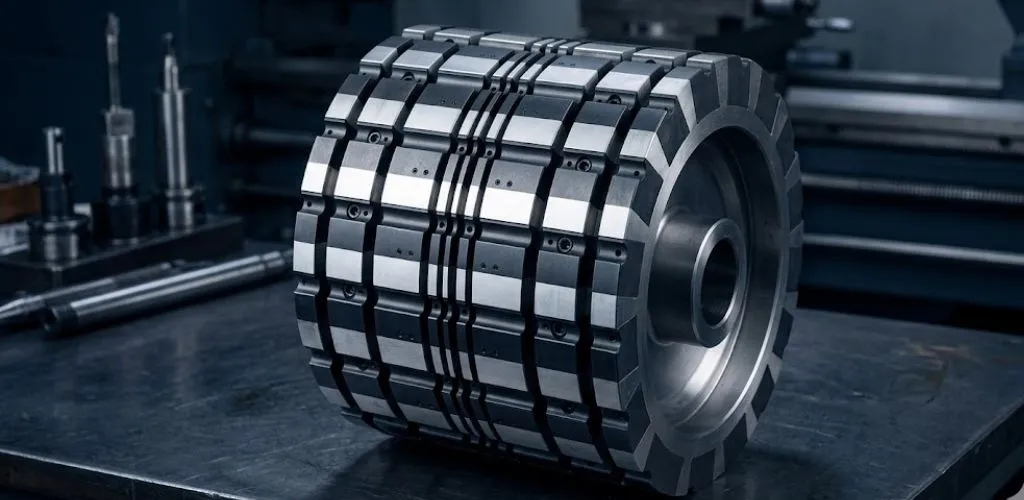
Flute Drum is a rotating cylindrical component mounted at the transfer station of a cigarette making machine. Its flute drum function is to receive individual cigarettes from the cut-off knife station and transfer them accurately and at high speed toward the packing machine or accumulation conveyor.
The drum takes its name from the flutes — precisely machined grooves — cut into its cylindrical surface. Each flute is shaped to receive and hold one cigarette securely as the drum rotates. The cigarettes are held in the flutes by a combination of the groove geometry and in many cases by suction — negative air pressure applied through channels in the drum body — that holds each cigarette firmly in its flute during the transfer arc.
The Flute Drum rotates continuously during machine operation, picking up cigarettes from the cutting station at one point in its rotation and releasing them at another — transferring them smoothly into the next stage of the production process. This action happens thousands of times per minute, making the Flute Drum one of the highest-cycle components on the entire cigarette making machine.
How Flute Drum Works and How It Affects Cigarette Transfer Quality
Understanding how flute drum works in the cigarette making process is essential for diagnosing transfer-related quality problems. The cigarette transfer quality flute drum relationship is direct — the drum’s surface condition, flute geometry, and rotational precision determine how consistently cigarettes are handled between the cutting station and the downstream process.
| Stage | Role of Flute Drum |
| Cigarette Receipt | As the cut-off knife severs individual cigarettes from the continuous rod, the Flute Drum receives each cigarette into a flute groove — picking it up at precisely the right point in the drum’s rotation. |
| Suction Hold | On machines with suction-assisted drums, negative air pressure through the drum body holds each cigarette securely in its flute during the transfer arc — preventing rolling, shifting, or dropping. |
| Transfer Arc | The drum rotates through the transfer arc, carrying cigarettes from the receipt point to the release point — maintaining their position, orientation, and spacing throughout the transfer. |
| Cigarette Release | At the release point, the flute drum releases each cigarette — either by cutting the suction or by the geometry of the flute — transferring it accurately into the downstream accumulation or packing process. |
Key Point: Any deviation in flute geometry — caused by surface wear, damage, or contamination — changes how cigarettes are held and released during the transfer arc. Even small dimensional changes in the flute profile cause misalignment, rolling, or dropping of cigarettes — directly increasing the reject rate and reducing transfer quality.
Which Cigarette Making Machines Use a Flute Drum?
Flute Drum is a standard transfer component across all continuous-rod cigarette making machines. The most common machines include:
| Machine | Manufacturer | Notes |
| Protos 70, 80, M5, M8 | Hauni / Körber | Flute drum spec varies between Protos variants |
| Molins Mark 8 | Molins | Legacy machine — confirm drum spec before ordering |
| Molins Mark 9 | Molins | Higher speed variant — different flute drum specification |
Important: Flute drum dimensions, flute count, flute geometry, and suction configuration differ between machine models and variants. Always confirm your exact machine model and drum specification before ordering a replacement.
Why Does Flute Drum Wear Out?
The Flute Drum operates under extreme mechanical demands — rotating continuously at high speed while handling individual cigarettes thousands of times per minute. Understanding the causes of wear helps maintenance engineers anticipate replacement timing and identify when accelerated wear is being caused by a secondary problem on the machine.
1. Surface Wear on Flute Profiles
The most common cause of Flute Drum deterioration is gradual surface wear on the flute profiles. Each time a cigarette is received into and released from a flute, there is mechanical contact between the cigarette paper and the flute surface. Over millions of cycles, this contact causes micro-abrasion of the flute edges and base — gradually changing the flute geometry and reducing the drum’s ability to hold and position cigarettes accurately.
2. Tobacco and Debris Accumulation in Flutes
Fine tobacco particles, paper dust, and adhesive residue accumulate within the flute grooves during production. This accumulation reduces the effective depth of the flutes — causing cigarettes to sit higher than designed and altering the contact geometry during transfer. Accumulated debris also creates uneven surfaces within the flutes that cause cigarettes to roll or shift during the transfer arc, reducing transfer accuracy.
3. Suction Channel Blockage
On suction-assisted Flute Drums, the suction channels that hold cigarettes in position during transfer can become partially blocked by tobacco particles or adhesive deposits. Reduced suction in individual flutes causes those flutes to release cigarettes prematurely during the transfer arc — resulting in dropped or misaligned cigarettes and a corresponding increase in rejects.
4. Mechanical Impact Damage
Foreign objects entering the cigarette stream — hard tobacco stems, paper fragments, or machine debris — can cause impact damage to flute profiles when they pass through the drum. Even a single impact event can deform one or more flutes enough to cause transfer problems on the affected flute positions. Regular inspection of flute surfaces is essential to identify impact damage before it causes significant production disruption.
Flute Drum Wear Signs: When Does It Need Replacing?
Watch for these flute drum wear signs during machine operation and routine inspection:
- Increased cigarette rejects from transfer misalignment — The most direct indicator — if cigarettes are arriving at the packing machine misaligned, off-pitch, or in irregular groups, the flute drum is not transferring consistently.
- Cigarettes dropping between stations — If cigarettes are falling between the cutting station and the accumulation conveyor, the flute drum is failing to hold them during the transfer arc — likely due to worn flutes or blocked suction channels.
- Visible flute surface wear or deformation — Any visible rounding, grooving, or deformation of the flute profile during inspection is a clear replacement indicator — even if transfer quality has not yet visibly deteriorated.
- Tobacco or debris buildup in flutes — Heavy accumulation in the flute grooves that cannot be cleared by routine cleaning indicates that the flute geometry has worn enough to trap debris — replacement should be considered.
- Increased noise or vibration from the drum section — Mechanical noise or vibration from the flute drum area during operation indicates wear on the drum’s bearing or rotational components — which should be investigated and addressed promptly.
How a Worn Flute Drum Affects Cigarette Quality and Production
Flute Drum condition affects both cigarette quality and production efficiency:
| Parameter | Effect of Worn Flute Drum | Production Impact |
| Transfer Accuracy | Cigarettes misalign during transfer arc | Packing machine rejects increase |
| Cigarette Integrity | Impact on cigarette surface during transfer | Paper damage, tobacco loss |
| Production Speed | Speed may need reducing to compensate | Reduced output per shift |
| Downstream Packing | Misaligned cigarettes disrupt packing sequence | Packing rejects compound |
| Machine Stoppages | Dropped cigarettes cause jams | Unplanned downtime increases |
How to Source a Replacement Flute Drum
The Flute Drum is a precision-machined component where dimensional accuracy is critical. A replacement drum with incorrect flute geometry, wrong flute count, or incorrect suction channel configuration will not perform correctly regardless of material quality. Here is what to verify before ordering a flute drum replacement:
- Confirm your exact machine model and Flute Drum specification — flute count, drum diameter, flute geometry, and suction configuration differ between Protos variants, Mark 8, and Mark 9
- Provide the part reference number from your machine documentation where available
- Verify the supplier manufactures flute drums in-house — flute profile accuracy requires controlled machining that resellers cannot guarantee
- Ask whether dimensional conformance is verified against original specifications — flute depth and profile geometry must match the original exactly
- Confirm material grade — the drum body and flute surfaces must be manufactured from materials appropriate for continuous high-speed operation
- Check stock availability — Flute Drum is not a daily consumable but should be held in planned maintenance stock for legacy machines
Orchid Spare Parts manufactures flute drums for all major cigarette making machines including the Protos, Molins Mark 8, and Molins Mark 9. If your Flute Drum has been discontinued or cannot be sourced through standard channels, our Diagram to Spare Parts service can manufacture a replacement from a technical drawing or sample component.
Related Components to Inspect When Replacing the Flute Drum
When replacing the Flute Drum, inspect these related components at the same time:
- Cut-Off Knife — The cut-off knife feeds cigarettes directly into the Flute Drum. A worn knife producing irregular cigarette ends can accelerate flute wear and cause transfer problems that appear to be drum-related.
- Garniture Assembly — Poor rod formation quality upstream — caused by a worn garniture — produces cigarettes with inconsistent diameter that do not sit correctly in the flute grooves, accelerating flute wear.
- Suction Bands — Inconsistent tobacco delivery affects rod density and diameter variation — which in turn affects how cigarettes interact with the Flute Drum during transfer.
For a complete overview of how these components work together, read our guides on What is Garniture Assembly, What is Suction Band, What is Cut-Off Knife, and Cigarette Rod Formation Problems.